News Story
Wachsman on Fuel Cells Chosen for ACS Bulletin Cover Story
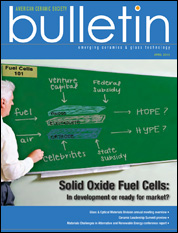
Solid oxide fuel cells (SOFCs) are promising devices for generating energy in an environmentally friendly way by a direct conversion of fossil and renewable fuels into electricity and high-quality heat. While the technology has been explored for decades (at least 70 years, according to Bulletin editor Peter Wray) technical challenges have slowed their development and large-scale deployment. But these are gradually being overcome, and more products are entering the market. Interest in SOFC solutions has risen sharply: Singhal and Wachsman point out that since 1989, the proceedings of the International Symposium on Solid Oxide Fuel Cells has grown from 60 pages to over 1000.
Singhal and Wachsman outline the U.S. Department of Energy's fuel cell program's three focus areas (cost reduction, coal-based systems, and research and development); fuel cell stacks currently being used in heat and power systems around the world; an overview of recent findings on materials tested for use in SOFC components; and the demand for SOFCs for use in vehicles, particularly trucks that could use an auxiliary power system for refrigeration and other functions without having to run their diesel engines.
The authors also discuss two of the biggest obstacles to widespread implementation of fuel cell technology: operating temperature and maintaining high power densities. A "tremendous effort" was required to lower typical SOFC operating temperatures from 1000°C to 800°C, but this still requires them to be constructed of specialized (and therefore more costly) materials. At present, if the operating temperature is lowered too much—a temperature closer to 100°C is the current goal—the SOFC's power output sharply drops. Advances in anode and cathode technology and the development of higher-conductivity electrolytes may help overcome this problem.
For More Information:
See E.D. Wachsman and S.C. Singhal, "Solid oxide fuel cell commercialization, research and challenges," American Ceramic Society Bulletin, 89 (3) 2010.
Published November 7, 2010
Related Stories
Stories / April 1, 2013
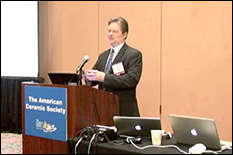
Wachsman Talks Fuel Cells on "Ceramic Tech Today" (VIDEO)
Stories / October 10, 2012
Wachsman Pioneers Transformational Energy Technology

Stories / February 21, 2014
International Association for Hydrogen Energy Honors Wachsman...

Stories / November 8, 2012
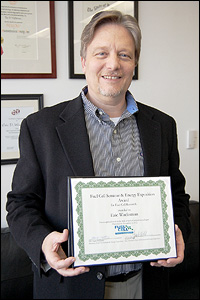
Wachsman Wins Fuel Cell Seminar & Energy Exposition Award
Stories / December 2, 2011
Solid Oxide Fuel Cell Research Sparks Media Coverage
Stories / June 23, 2014
UMD Professors Join Fuel Cell Projects Awarded Combined $11.4M

Stories / October 30, 2013
25 Kilowatts in a Redox Box: Affordable Fuel Cell, Cheaper Power
Stories / January 22, 2013
Eric Wachsman Chosen as Solar 2013 Conference Chair

Stories / September 7, 2012
Wachsman Tapped for Grid Reliability Panel
Stories / April 2, 2012
Foundation Supports Gore's Efforts to Improve Fuel Cells